
How about making your employees feel truly "valued" and hearing their voice?
I had to take a break from my blog posts for a while, but starting this week we'll be back with new articles.
To kick things off after the break, I wanted to cover a topic that all of us actually need. We decided to look at "mental health," or "emotional and psychological well-being," a topic that has recently been at the center of attention across the entire HR world.
What is mental health? What affects it? How can it be improved? How can companies and organizations do more to support and protect their employees' mental health? Let's begin an article in which we look for short answers to questions like these. Enjoy the read.
What is mental health?
As we all know, mental health is a deep-rooted and important topic. It is one of the most important fields in psychology and modern medicine. But from the perspective of corporate and working life, it would be fair to say that its importance has grown over the last year and a half because of the pandemic. Perhaps, more accurately, we could even say that people are only now beginning to understand what this concept is and how important it is. Over the past year and a half, companies have focused far more than before on their employees' psychological state, their happiness and well-being, how they are doing mentally and how they feel. Some did so partly out of necessity, others willingly, because they truly cared. The extraordinary period we have been living through, the impact of the pandemic and the reality of working from home also triggered this. As a result, another important stop has appeared on our path for the time ahead.
What Are the Determining Factors?
Let us also share an important note here: in its simplest definition, mental health can be described as "a person's state of being mentally and emotionally well." But it doesn't cover only these. On the contrary, emotional health is just one dimension of mental health, and there are six more dimensions like it that affect mental health. Your physical conditions, your diet and sleep patterns, your home life, your working environment at home, your other responsibilities, your intellectual background, and the person or people you live with and their circumstances all have a direct effect on your mental health.
How close are you to your employees while they are far away?
With rising vaccination rates and falling case numbers, a gradual return to the office has begun, yet many companies are still working from home and have announced that they will continue to do so after the pandemic. Some are also accelerating their move to hybrid models. But with all of this, there are two big realities in front of us:
- We remain more distant from our employees and our companies than before. Last year this distance was only about "physical distance," but as time goes on, "emotional distance" has come much more to the fore. Many people around me say that, even if everything returns to normal, they no longer want to go back to the office, psychologically speaking. Of course, these are people who focus on the positive, beneficial sides of working from home or remotely 😊
- On the other hand, as remote working continues, its wearing effects have gradually started to become more apparent. Last year we were not really aware of them. So much was changing in our lives at once, and because working remotely made us feel safer and seemed "relatively comfortable" at first, we didn't see its downsides much, but research has slowly started to reveal them too.
Data from two studies published this year clearly show that remote working can actually mean working "more" and working "under more stress."
- During the pandemic, McCulley conducted a study examining the working hours of people working from home. 38% of respondents said they worked much longer hours during the remote working period than before. (McCulley, 2021).
- 27% of those working from home due to the global pandemic say they continue to work in their free time to meet work demands. (Eurofound, 2021).
So when that is the situation, when we are working remotely and actually working more, and "our other responsibilities" are added on top, the result can be a picture that is quite challenging in terms of mental health and that wears employees down.
What is the situation in Turkey?
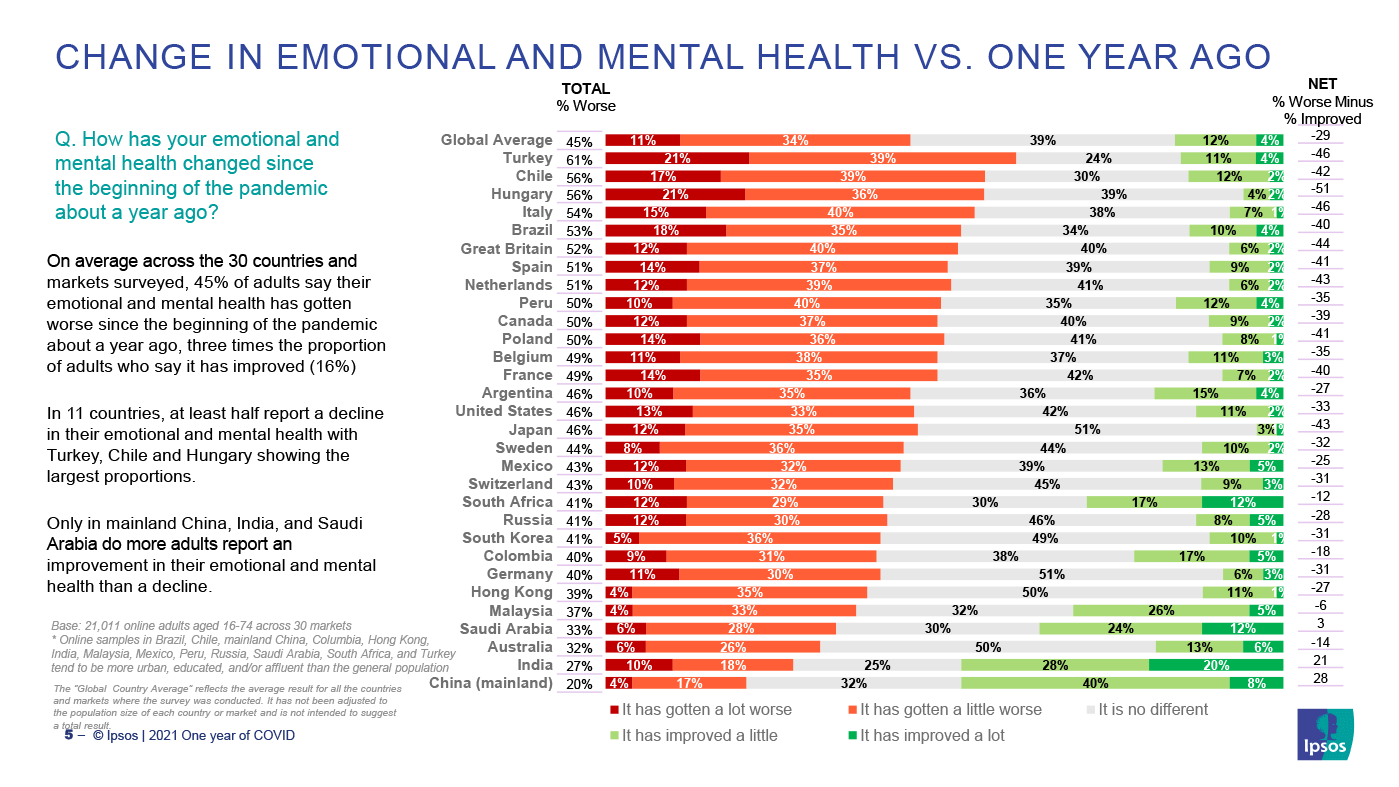
When we look at this picture from the perspective of our country, we face an even graver reality. One of IPSOS's recent studies, "One Year of COVID," focuses specifically on individuals' mental health. One of the survey's questions asks participants how their emotional and mental health has changed since the start of the pandemic, that is, over the past year.
On the global average, 45% of respondents said their emotional and mental health had worsened over the past year, while for Turkey this figure is 61%, the highest level. In other words, in Turkey, the mental health of 6 out of every 10 people is getting worse and worse. This is a truly striking figure that must be given serious thought.
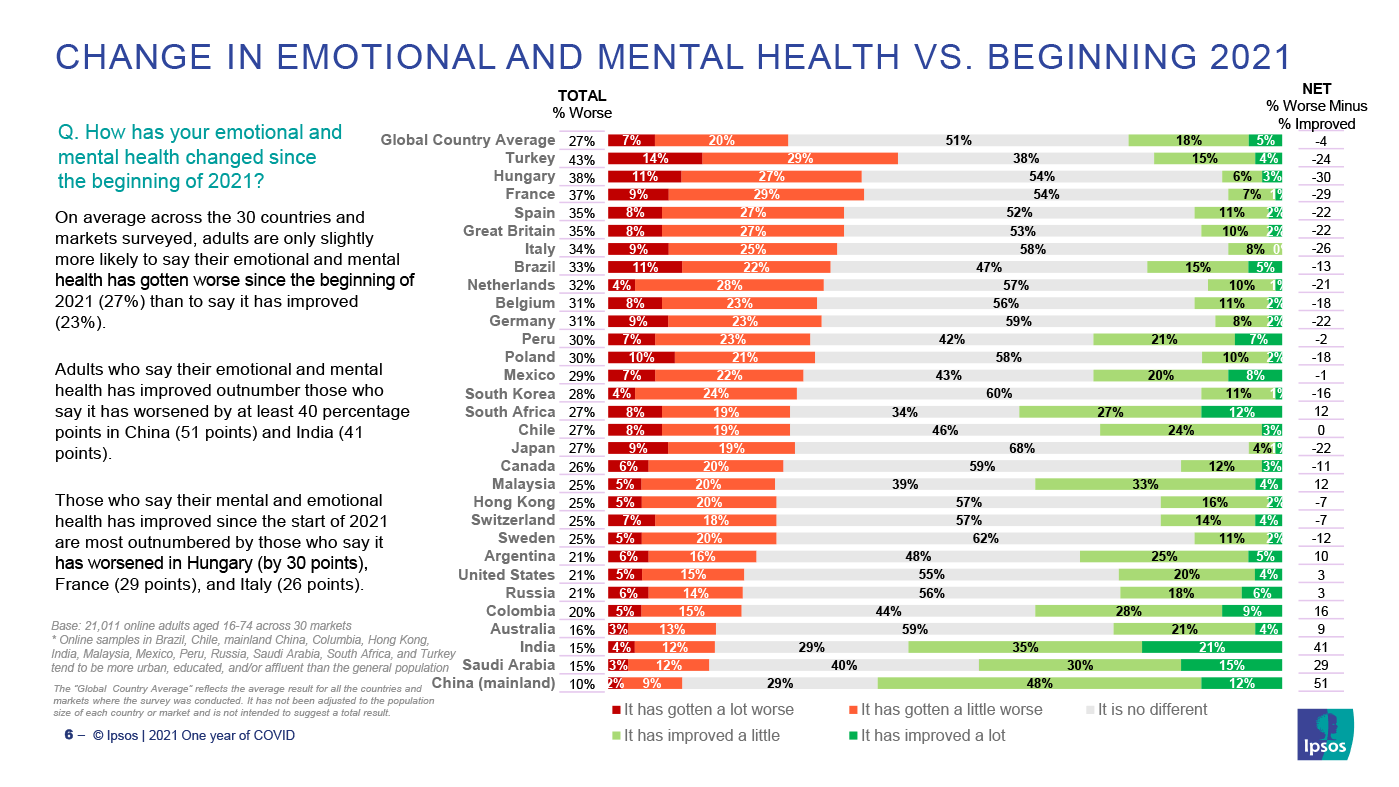
Another version of the same question asks how emotional and mental health has been affected and has changed since the start of 2021. Here, the overall average is 27%, while Turkey again has the highest figure at 43%. Of course, I can't help thinking that the main factors behind all this data are the country's increasingly negative economic trajectory and, as a result, people's growing "struggle to make ends meet." We were not a very happy country to begin with, but we are getting worse in this respect with each passing day ☹
In short, all of this data and research show that, as I mentioned at the beginning, people's emotional and mental health in Turkey will be one of the hottest topics of the coming period and will require a great deal of work.
As employers, companies and HR organizations, how aware are we of our employees' changing emotional states and new needs?
Since the start of the pandemic, companies and HR organizations have created various opportunities, as far as they could, to improve the quality of life of remote employees and to make it as easy as possible to overcome the unusual challenges of this extraordinary period, which we could not yet foresee at the beginning. But how sufficient or successful were these efforts, and ultimately how much did they serve "employee well-being"? The answers to these questions could be debated at length.
But to me, these seem to be exactly the points we need to think about and work on. What really matters for companies is being able to answer the question "what will employees need from now on?" And to do that, you first need to carry out the best possible "current state analysis."
So what solution do we offer?
As the Digital Institute team, building on some common themes we have heard from our clients and that they have consulted us about over the past year and a half, and in addition to the other employee surveys we have run so far, we are making a new survey available to you and to all our clients who need it.
We know that every company and HR team always wants to offer the best to its employees. But before doing so, as we said, the first step is to reveal the "current state" as accurately as possible and to analyze it in the best way. This is exactly where our proposed solution for you comes in: the Mental Health Survey.
To better understand the state of your employees' emotional and mental health and to see their needs much more clearly, we recommend that you first run the "Mental Health Survey" in your company.
- With our rich question set, developed by a team of experts in the field, we focus on employees' emotional health across 7 separate dimensions, giving companies the opportunity to gather data and feedback on what they need to do.
- Besides being a very clear and robust current state analysis supported by different areas of focus, this survey also makes it possible for companies to see the obstacles and blocks employees are experiencing and to create timely and concrete support opportunities and areas to address them.
Our Main Focus: Happy Employees
We know that all of us are focused on our employees' happiness and are ready to do whatever we can for it. Especially now, when it is so clear that in the period ahead the companies that do more for their employees' happiness, health and well-being will win more hearts and take firmer steps, come and take your first step on this path, and do your employees and yourself a favor with the "Mental Health Survey" 😊 Make them feel more valued, and as a company, make the investment your future and your well-being need, starting today.
If you would like more detailed information about the survey, you can get in touch with us at any time.
See you in the next article,
Stay healthy,