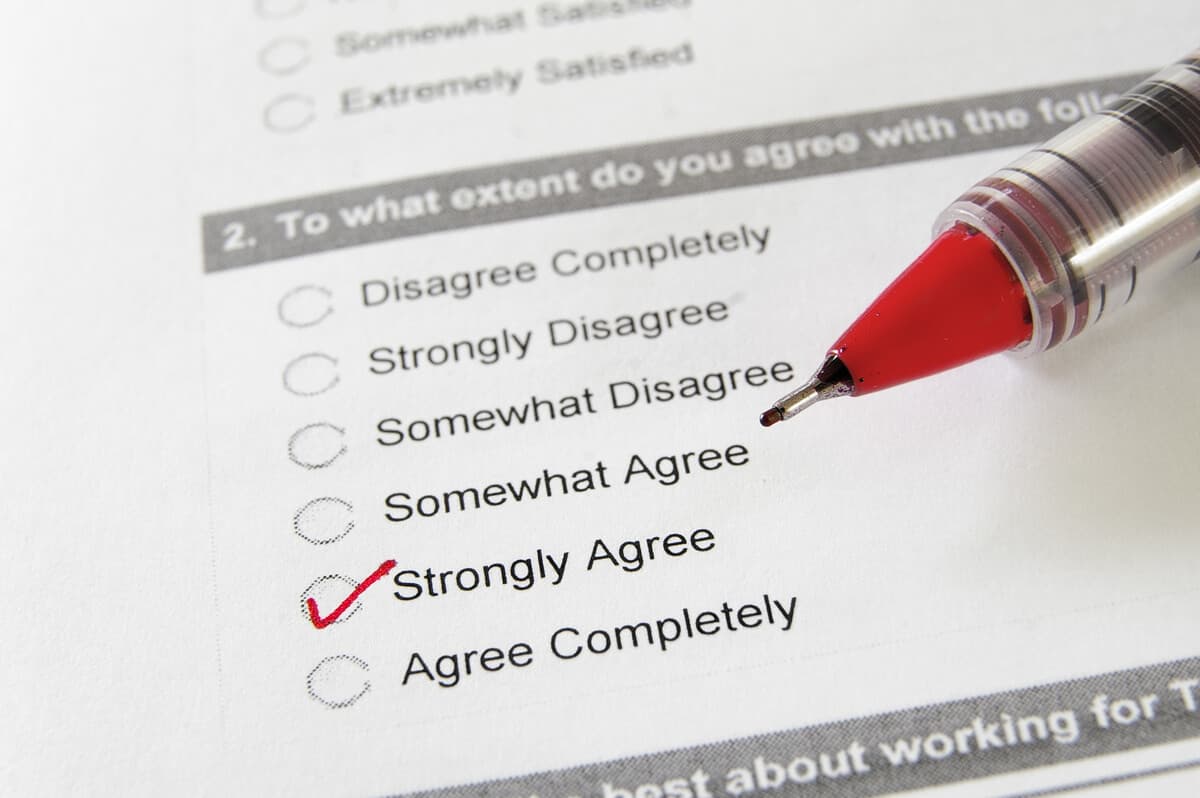
Employee engagement survey questions fall into two groups: index statements that measure engagement itself (intention to stay, advocacy, pride, discretionary effort) and category statements that measure the areas that drive engagement (manager, career, recognition, communication, culture and so on). Below you will find more than 70 sample statements across 12 categories, along with the 12 most effective questions for a short pulse survey.
- An engagement survey has two types of questions: index statements that measure engagement itself, and category statements that show what drives engagement.
- Items are written as statements rather than questions and answered on a 5-point Likert scale.
- For a short pulse survey, the 12-question set at the end of this article is a good starting point.
We explained what an engagement survey measures and how its results are interpreted in our article what is an employee engagement survey. All statements are written to be answered on a 5-point Likert scale ranging from "Strongly disagree" to "Strongly agree." Our guide how to create an employee engagement survey explains step by step how to place these questions in a survey, how many to use and how to choose the scale. If you are preparing a survey focused on satisfaction, take a look at our article on employee satisfaction survey questions.
Engagement index questions
These statements measure engagement itself and should be asked unchanged every year, so that you can compare results across years and across organizations.
- I am proud to work for this organization.
- I would recommend this organization to my friends as a place to work.
- I see myself still working at this organization two years from now.
- Even if I received a similar offer from another organization, I would prefer to stay here.
- I am willing to go beyond what is expected of me to help my organization succeed.
- This organization motivates me to do my very best.
In addition, a single eNPS question can be used: "On a scale of 0 to 10, how likely are you to recommend this organization to a friend as a place to work?" This question is asked on its own 0–10 scale and reported separately; we explained how it is calculated in our article what is eNPS.
Manager and leadership questions
The direct manager is one of the biggest drivers of engagement. In this category, measure the direct manager and senior leadership with separate statements. If you want to give every manager detailed feedback from their own team, see our article on manager evaluation survey questions.
- My manager clearly communicates what is expected of me.
- My manager gives me regular, constructive feedback on my work.
- I can comfortably share my ideas and concerns with my manager.
- My manager takes an interest in my development.
- My manager handles disagreements within the team fairly.
- My manager communicates the organization's goals and priorities well to the team.
- I believe senior leadership is taking the organization in the right direction.
- Senior leadership's decisions are consistent with the organization's values.
Company culture and values questions
- My organization's values are genuinely put into practice day to day.
- Our organization's mission and vision inspire me.
- Different opinions can be expressed openly in this organization.
- People are treated with respect in our organization.
- In our organization, I can try out new ideas without fear of making mistakes.
- Decisions in our organization are made and communicated transparently.
Role and job questions
- My duties and responsibilities are clear to me.
- I know how my work contributes to the organization's goals.
- My knowledge and skills are put to good use in my job.
- I have enough say in decisions about my work.
- The work I do feels meaningful to me.
- My job challenges me and helps me grow.
- I have the tools and resources I need to do my job well.
Career and development questions
- I believe I can advance my career at this organization.
- Promotion and job change decisions are made fairly in our organization.
- I am supported in developing the new skills my job requires.
- The training I receive is genuinely useful in my work.
- I have learned something new at this organization in the past year.
- I can access mentoring or coaching support when I need it.
Communication and feedback questions
- I am kept informed in a timely way about what is happening in the organization.
- Changes that affect my work are explained to me clearly and in advance.
- There are channels through which I can share my ideas and suggestions.
- I can see that the feedback I give is taken into account.
- It is easy to collaborate with other teams.
Recognition and rewards questions
- When I do a good job, it is noticed and appreciated.
- My manager sees my contributions.
- Rewards in our organization are fair and consistent.
- My pay is fair given the work I do and my contribution.
Team and collaboration questions
- We trust one another in my team.
- My teammates take care to do high-quality work.
- I can get support from my teammates when I need it.
- I feel like a valued member of my team.
Workload and well-being questions
This area, which has become a fixture on organizations' agendas since the pandemic, is important for spotting burnout risk early. Write these questions so that they focus on work-related conditions without intruding into people's private lives.
- My workload is reasonable.
- I am able to maintain a healthy balance between work and my personal life.
- I can get support from the organization to manage work-related stress.
- I do not feel exhausted at the end of the day.
- Our organization cares about employees' physical and mental health.
- I feel comfortable taking time off when I need to.
Work environment and hybrid work questions
- My physical work environment helps me work productively.
- My work environment is safe.
- Our remote or hybrid working arrangement has a positive effect on my productivity.
- I have the tools I need to stay connected with my team when working remotely.
- The volume of meetings and digital communication does not stop me from focusing on my work.
Change, digital transformation and AI questions
If your organization is going through a transformation, this category shows how the change is perceived by employees. For this year's key topics, see our article on employee engagement trends 2027.
- The reasons for changes in our organization are explained to us clearly.
- Our views are sought during change processes.
- AI and automation tools make my work easier.
- I receive the training and support I need to adapt to new technologies.
- Our organization uses its resources wisely to improve productivity.
Diversity and inclusion questions
- I can be myself at this organization.
- Everyone in our organization is given equal opportunities regardless of their background.
- I believe our organization genuinely supports diversity and inclusion.
- Our organization's environmental and social responsibility initiatives feel meaningful to me.
Open-ended engagement survey questions
Limit open-ended questions to 2–3; more than that lowers the quality of the answers and makes the analysis harder. For more examples and how to analyze the answers, see our article on open-ended employee survey questions.
- What do you like most about working at this organization?
- If you could change one thing to improve your work experience, what would it be?
- Do you have any suggestions for improving your own work or your team's processes?
- How are AI and automation affecting your work?
- What is the most important thing that keeps you at this organization?
The 12 most effective employee engagement survey questions
If you are running a short pulse survey during the year, or measuring engagement for the first time, the set below is a good starting point. Each item represents one of the areas we have found to have the greatest impact on engagement:
- I am proud to work for this organization.
- I would recommend this organization to my friends as a place to work.
- I see myself still working at this organization two years from now.
- I am willing to go beyond what is expected of me to help my organization succeed.
- My manager clearly communicates what is expected of me.
- My manager gives me regular, constructive feedback on my work.
- I know how my work contributes to the organization's goals.
- I believe I can advance my career at this organization.
- When I do a good job, it is noticed and appreciated.
- My workload is reasonable.
- I can see that the feedback I give is taken into account.
- If you could change one thing to improve your work experience, what would it be? (open-ended)
Things to keep in mind when using these questions
- Adapt them to your organization's language. Replace words with the expressions commonly used in your organization, without changing the meaning of the statements.
- Keep the index fixed. Ask the engagement index statements the same way every year; update the other categories according to your agenda.
- Use negatively worded statements sparingly. Negatively worded statements such as "I do not feel exhausted at the end of the day" can be answered incorrectly when read carelessly; keep their number limited. If you use statements where agreement has a negative meaning, such as "I often think about changing jobs," remember to reverse their scores in the analysis.
- Simplify for blue-collar employees. In surveys for field and production employees, reduce the number of statements and keep the language even simpler.
Frequently asked questions
What are the most fundamental questions for measuring employee engagement?
Statements measuring intention to stay ("I see myself still working at this organization two years from now"), advocacy ("I would recommend this organization to my friends as a place to work"), pride in the organization and willingness to go above and beyond form the basis of the engagement index.
Why are engagement survey items written as statements rather than questions?
A Likert scale measures how strongly you agree with a statement. A question like "Does your manager give you feedback?" invites a yes/no answer, whereas the statement "My manager gives me regular feedback" is suited to measuring the degree of agreement.
Should I use all of these questions in the same survey?
No. Keep the engagement index statements fixed and choose the statements from the other categories that fit your organization's agenda. For an annual survey, 40–60 statements are usually enough.
What is the difference between satisfaction questions and engagement questions?
Satisfaction questions measure how content employees are with what they receive from the organization, such as pay, benefits and working conditions. Engagement questions measure employees' emotional connection to the organization, their intention to stay and their willingness to put in extra effort.