Employee satisfaction survey questions measure how content employees are with what they receive from the organization: pay and benefits, working conditions, work-life balance, their relationship with their manager, tools and resources, and development opportunities. Below you will find sample items in 10 categories that you can adapt directly to your survey.
- Satisfaction questions measure how content employees are with what they receive from the organization (pay, conditions, opportunities).
- Opening each category with a single overall satisfaction item and then asking about that area's subtopics makes the results easier to interpret.
- If you want to measure emotional connection to the organization and intention to stay, you should add engagement questions alongside the satisfaction questions.
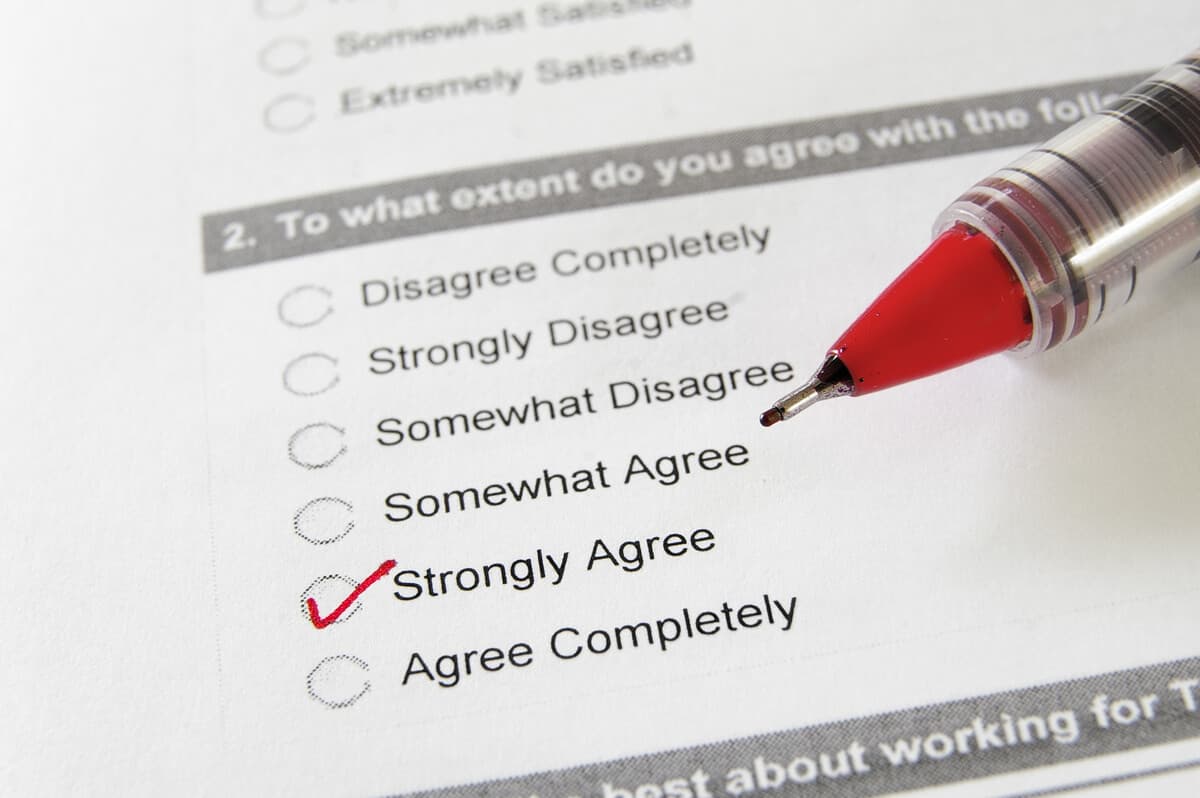
The items are written to be answered on a 5-point Likert scale ranging from "Strongly disagree" to "Strongly agree." If you also want to measure employees' emotional connection to the organization, their intention to stay and their willingness to go the extra mile, add the items from our article on employee engagement survey questions. We explain the difference between the two concepts in this article, and what a satisfaction survey measures and how to interpret the results in our article what is an employee satisfaction survey.
Overall satisfaction questions
- Overall, I am satisfied working at this organization.
- I am satisfied with the work I do.
- My working conditions at this organization compare well with those at similar organizations.
Pay and benefits questions
- I am satisfied with my pay.
- My pay is in line with the responsibilities of my job.
- My pay is fair compared with what others doing similar work in the market earn.
- I know how pay increases are determined at our organization.
- I am satisfied with benefits such as health insurance, meals and transportation.
- The benefits meet my needs.
Working conditions and physical environment questions
- I am satisfied with my physical work environment (lighting, noise, temperature, layout).
- My work area is clean and well maintained.
- My work environment is safe in terms of occupational health and safety.
- Rest, dining and social areas meet my needs.
- My working hours and shift schedule are reasonable.
Work-life balance and flexibility questions
- I am able to maintain a healthy balance between my work and personal life.
- I can take time off when I need to.
- I have the flexibility I need in my working hours.
- I am satisfied with the remote or hybrid working options.
- I am not expected to be available for work outside working hours.
Relationship with manager questions
- I am satisfied working with my manager.
- My manager treats me with respect.
- I can reach my manager when I need to.
- My manager treats the team fairly.
- My manager helps me solve problems related to my work.
Team and coworker questions
- I am satisfied working with my teammates.
- There is a good working atmosphere on my team.
- I get the support I need when working with other departments.
Tools, equipment and resources questions
- I have the tools and equipment I need to do my job.
- The computer, software and systems I use make my job easier.
- I can easily access the information I need to do my job.
- We have enough people for our team's workload.
Job security and stability questions
- I feel that my job is secure at this organization.
- I am confident about our organization's future.
- Our organization fulfills its obligations to employees on time.
Training and development opportunity questions
- I am satisfied with the training opportunities our organization offers.
- I can access the training I need for my job.
- Our organization offers enough opportunities for me to develop myself.
Internal communication and information questions
- I am kept sufficiently informed about what is happening in the organization.
- Decisions that affect me are announced in a timely way.
- I am satisfied with the channels through which I can share suggestions and complaints.
Open-ended satisfaction survey questions
Limit open-ended questions to 2–3; they reveal the reasons that closed questions cannot show. For more examples, see our article on open-ended employee survey questions.
- What do you find most satisfying about working at this organization?
- If you could change one thing about your working conditions, what would it be?
- What would you suggest our organization do to increase your satisfaction?
Things to keep in mind when using these questions
- Open each category with an overall item. Starting with a general item such as "I am satisfied working with my manager" and then asking about the subtopics lets you see both the overall score and the source of the problem in the report.
- Weigh questions that may create expectations. Questions about pay and benefits can create an expectation among employees that changes will be made. If you are not ready to act in this area based on the results, set the scope of the questions accordingly.
- Adapt them to your organization's language. Use wording that is familiar in your organization without changing the meaning of the items. Simplify the language further for field and production employees.
We explain how to structure the whole survey, how many questions to use and how to plan the fieldwork in our guide how to create an employee engagement survey.
Frequently asked questions
What topics should an employee satisfaction survey cover?
The most commonly used categories are overall satisfaction, pay and benefits, working conditions, work-life balance, relationship with the manager, coworkers, tools and resources, job security, training opportunities and internal communication.
How many questions should a satisfaction survey have?
For a survey focused solely on satisfaction, 25–40 items and 2–3 open-ended questions are usually enough. In a comprehensive survey that also measures engagement, the total can rise to 40–60 items.
What scale should satisfaction questions be answered on?
A 5-point scale ranging from "Very dissatisfied" to "Very satisfied," or from "Strongly disagree" to "Strongly agree," is the most common choice. What matters is using the same scale throughout the survey.