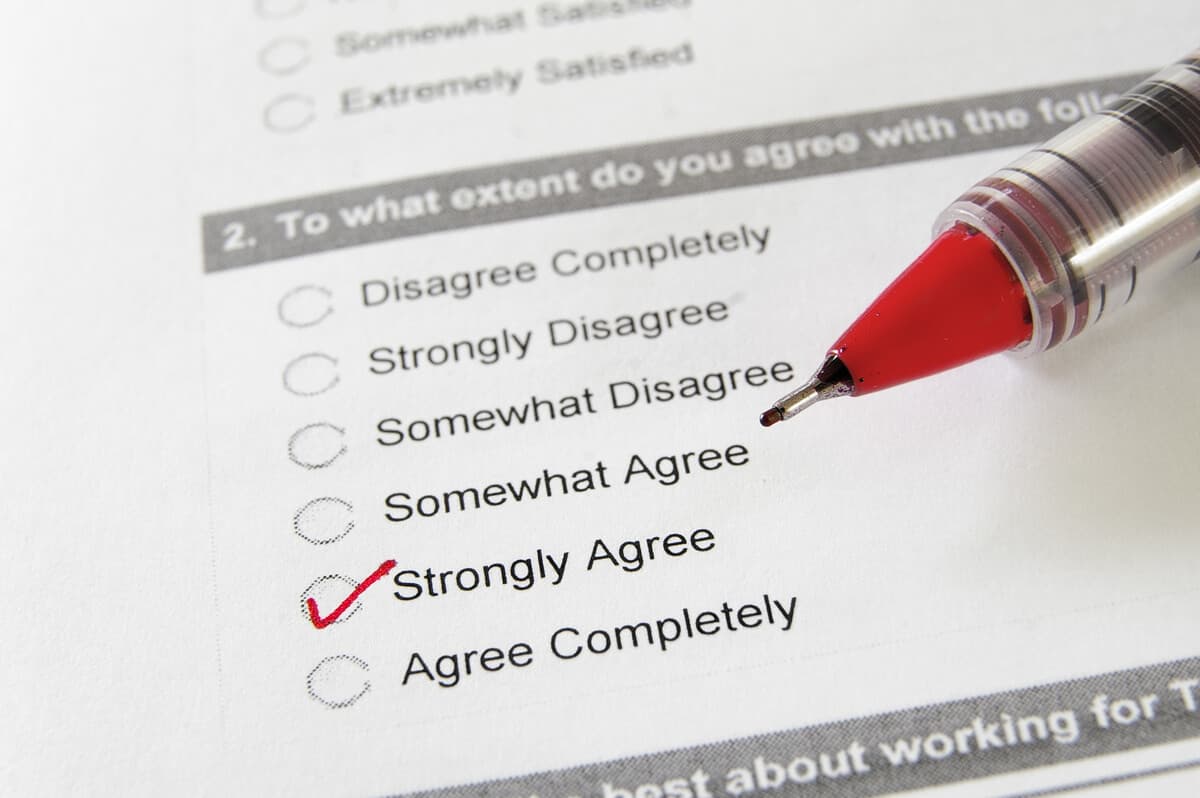
Open-ended employee survey questions are questions that employees answer in their own words, without being limited to predefined options. They reveal the reasons behind the scores shown by closed-ended questions, unexpected problems and employees' concrete suggestions. 2–3 open-ended questions in an annual survey and 1 in a pulse survey are usually enough. Below you will find sample questions by topic, how to write a good open-ended question and how to analyze the answers.
- Open-ended questions reveal the reasons behind the scores shown by closed-ended questions, as well as employees' suggestions.
- 2–3 open-ended questions in an annual survey and 1 in a pulse survey are usually enough; the more you add, the lower the quality of the answers.
- The most useful open-ended questions focus on a single topic, are not leading and ask for a concrete suggestion.
- Rather than being read one by one, answers should be coded and counted by topic, and reported with any identifying details removed.
We explained the general difference between open-ended and closed-ended questions, and when to use which, in our post open-ended vs. closed-ended questions. This post focuses on examples specific to employee surveys.
General Experience Questions
These are the most frequently used questions in annual surveys, and the ones that get the most answers:
- What do you like most about working at this organization?
- If you could change one thing to improve your work experience, what would it be?
- What does our organization need to do to become a better place to work for employees?
- Is there anything else you would like to add?
Engagement and Intent-to-Stay Questions
- What is the most important thing that keeps you at this organization?
- What would lead you to look for another job?
- When did you feel most motivated at this organization?
- If you were recommending this organization to a friend, what would you tell them about most?
Manager and Leadership Questions
- What is one thing you would like your manager to start doing?
- What is one thing you would like your manager to stop doing?
- What is your manager's greatest strength that you would like them to continue?
- What would you like senior leadership to do differently in how it communicates with employees?
The "start, stop, continue" structure is especially useful in manager evaluations because it gives managers feedback they can act on directly. You can find more manager questions in our post on manager evaluation survey questions.
Company Culture and Values Questions
- How would you describe our organization's culture in three words?
- Can you give an example of where our organization's values are best reflected in day-to-day work?
- Is there a behavior in our company culture that you would like to see change?
- What would you tell a new starter if you were explaining "how things work around here"?
Career and Development Questions
- Which skill would you like to develop over the next year?
- What support from the organization do you need most for your development?
- What is the biggest obstacle to taking the next step in your career?
- What have you learned most in your job over the past year?
Workload and Well-Being Questions
In these questions, focus on work-related conditions rather than the employee's private life or health.
- What takes up most of your time when doing your job?
- What needs to change to make your workload more manageable?
- What can the organization do to reduce your work-related stress?
Processes, Tools and Resources Questions
- Which process or approval step slows you down the most in your work?
- If there were one tool or resource that would make your job easier, what would it be?
- Which department is hardest for you to work with, and why?
Communication Questions
- Through which channel do you mostly find out what is happening in the organization?
- On which topic would you like to be informed more, or earlier?
Change and Transformation Questions
Questions you can add if your organization is going through a period of change:
- What has been the biggest impact of recent changes on your work?
- What do you need to feel better during this period of change?
- How are AI and automation tools affecting your work?
- What would you like us to improve in our hybrid or remote working arrangement?
"Why?" Questions After a Closed-Ended Question
One of the most effective uses of open-ended questions is to ask about the reason for a score immediately after a closed-ended question. Asking this only of those who gave a particular answer, rather than all employees, keeps the survey short and shows the reasons directly:
- To those who give 0–6 on the eNPS question: "What is the most important reason for the score you gave?"
- To those who give 9–10 on the eNPS question: "What is the most important reason you would recommend our organization?"
- To those who disagree with the statement "I see myself still working at this organization two years from now": "What is the most important thing that makes you think about leaving?"
- To those who give a low score in a category: "What is the most important thing that needs to be improved in this area?"
We explained how the eNPS question is calculated in our post what is eNPS.
How to Write a Good Open-Ended Question
| Rule | Weak example | Better |
|---|---|---|
| Ask about a single topic | "What do you think about your manager and your team?" | Two separate questions: one for the manager, one for the team |
| Ask for a concrete suggestion | "What are your thoughts about the company?" | "If you could change one thing, what would it be?" |
| Don't lead | "Which features of our new office did you like?" | "How has your experience with our new office been?" |
| Keep it answerable in scope | "What do you think about the organization's 5-year strategy?" | "What is most unclear to you about the organization's goals?" |
| Ask for one thing | "Write all of your suggestions." | "Write your most important suggestion." |
In addition:
- Limit the number: Do not exceed 2–3 open-ended questions in an annual survey, or 1 in a pulse survey.
- Make them optional: Mandatory open-ended questions lead to meaningless answers and abandoned surveys.
- Put them at the end of the survey: Asking open-ended questions after the closed-ended ones means employees answer having already thought about the topics. "Why?" follow-up questions, however, should come immediately after the related closed-ended question.
- Remind people about anonymity: Right above the open-ended question, state that comments will be reported with any identifying details removed.
How to Analyze Open-Ended Answers
Rather than reading hundreds or thousands of comments one by one, follow a systematic method:
- Build a coding frame: Read a sample batch and identify topics such as career, manager, pay, workload, communication and tools. Keep the topics as aligned as possible with the survey's categories.
- Code the answers: Assign each comment to one or more topics and mark it as positive, negative or a suggestion.
- Count: Calculate how many comments each topic appears in and its tone. A finding like "31% of comments relate to career development, and most of them are negative" is far more powerful than individual quotes.
- Read them alongside the closed-ended questions: If the topics that come up most in open-ended comments overlap with the areas that score low in closed-ended questions, the priority area for action becomes clear.
- Look at breakdowns: Examine which department, location or tenure group the topics are concentrated in. You can use the methods in our post on segmentation in employee surveys for this.
- Select representative quotes: For each important topic, choose a few quotes that do not reveal identity and reflect the overall view on that topic. Prefer the most representative ones, not the harshest or most striking.
- Redact: Before reporting, remove names, job titles, project names and incident details from comments. For details, see our post on anonymity and KVKK (Turkey's Personal Data Protection Law) in employee surveys.
In surveys with thousands of comments, this process can be accelerated with text analysis and AI tools; however, an expert should check whether the coding frame fits the organization's agenda and whether the results are accurate. We explained how to set up this process in our post on AI analysis of open-ended comments.
Common Mistakes
- Asking too many open-ended questions: This lowers answer quality and makes the analysis unmanageable.
- Leaving comments unread: Comments that are collected but never analyzed kill employees' willingness to write comments in the next survey.
- Generalizing from a single comment: A striking comment may not reflect the views of all employees; always look at how often the topic comes up.
- Trying to identify who wrote a comment: This permanently damages trust in anonymity.
To plan open-ended questions together with the rest of the survey, take a look at our guide on how to create an employee engagement survey.
Frequently asked questions
How many open-ended questions should an employee survey have?
2–3 open-ended questions in a comprehensive annual survey and 1 in pulse surveys are usually enough. As the number of open-ended questions grows, the care employees put into their answers declines and the analysis workload increases.
Should open-ended questions be mandatory?
No. Mandatory open-ended questions lead to meaningless answers such as "nothing" or "-", or to people abandoning the survey halfway. When they are optional, you get fewer answers, but more valuable ones.
How do you analyze open-ended answers?
First, the answers are read and sorted into topics (for example career, manager, workload), the number of times each topic comes up is counted, and its positive or negative tone is determined. Then representative quotes that do not reveal anyone's identity are selected for each topic. When there are many answers, this process can be supported with text analysis tools.
Should open-ended comments be shared with managers?
They can be, but not on an individual basis: grouped by topic and stripped of any details that could reveal identity (names, projects, incidents). Comments from small teams should be combined with the parent unit before being shared.